
Qwen3.8-Max is Here First Max-Class Model Going Open Source
Alibaba drops Qwen3.8-Max with 2.4T total parameters and 95B active parameters. First Max-class open-weight model releasing next week on Hugging Face & ModelScope.


Table of Contents
Alibaba’s Qwen team dropped Qwen3.8-Max Today. The model sits at 2.4 trillion total parameters with 95 billion active ones. It is the biggest and strongest model they have shipped so far in the Qwen line. What makes this release different is the open-weight plan. For the first time a Max-class Qwen model will have its weights released. The team says the weights will go up on Hugging Face and ModelScope next week. They are also opening Qwen3.8-27B at the same time.
You can already use the model through the QwenCloud API. Official pricing sits at $2 per million input tokens and $6 per million output tokens. Cached input costs $0.25. The context window reaches one million tokens.
Rate Limits & Context
- Max Input - 991K
- Max Output - 131K
- Max Input (Thinking) - 983K
- Max Output (Thinking) - 131K
- Context - 1M
- Max Reasoning - 262K
- TPMTokens Per Minute - 2M
- RPM Requests Per Minute - 15K
The official post on the Qwen blog focuses heavily on coding and long-running work. One example they shared stood out. The model ran for sixteen days on its own and built a full project called oh-my-cli. It pushed 265 commits, opened 127 pull requests, and filed 151 issues without anyone stepping in. The full trace is available on GitHub if you want to dig through it.
They also showed the model reproducing a research paper and then improving on the original results. In another test, it handled a multi-day chip design task, cutting gate count sharply and meeting timing targets. These are the kinds of multi-step jobs most models still struggle with when left alone for long stretches.
On the agent side the model mixes coding with direct GUI control. It can move across Ubuntu, macOS, Windows, Android and the browser in the same session. Vision is baked into the planning and checking loop, so it can look at screenshots or long documents and adjust its next steps. The team claims it can process two-hundred-page PDFs and long video material and turn them into searchable knowledge graphs.
Benchmark numbers released with the model put it close to the current top closed models on several coding and agent suites. It leads on PaperBench with a 93.0 score. Results on Terminal Bench, FrontierSWE and a few internal Qwen coding suites sit in the same range as the strongest competitors right now (such as Claude Opus 5 and OpenAI's GPT-5.6 Sol). Full tables are in the official blog post if you want the exact numbers.
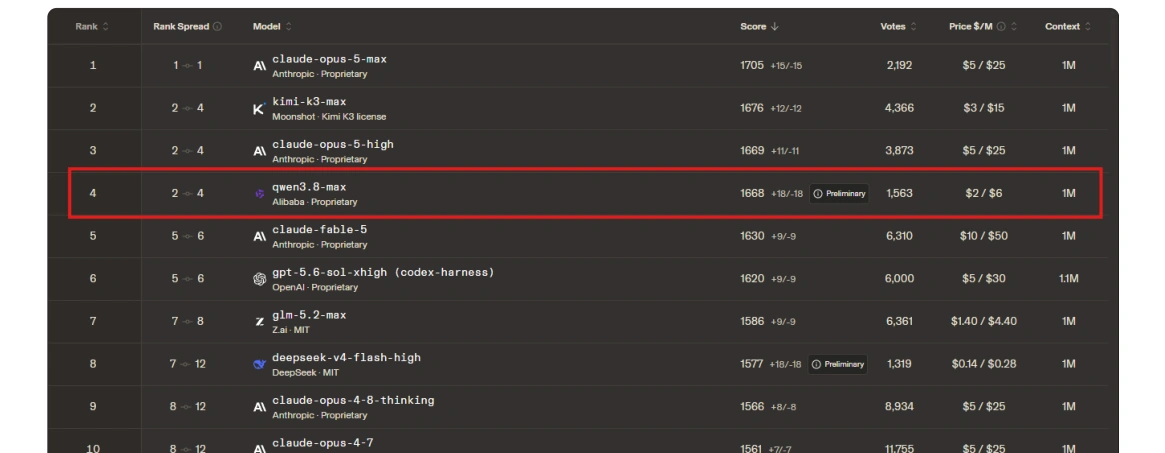
Qwen3.8-Max landed on the Arena leaderboards this week and the numbers are hard to ignore. It sits at #4 on the Frontend Code Arena with a score of 1668. It ranks #5 on the Text Arena at 1496. And it is currently #2 on the Vision Arena with 1305 points, only a narrow gap behind the leader.
Access is live today on Qwen Studio and through the QwenCloud API. Documentation for the first API call is at Qwen Claude. The model supports different reasoning effort settings and keeps thinking traces by default.
For anyone building coding agents or long-running automation tools, the combination of the API today and open weights next week is the practical part. You can start testing against the hosted version right away and then move to local or self-hosted runs once the weights land. The 27B version should be easier to run on more modest hardware while the full Max model will need serious resources. Also it comes with Qwen Code then you can use it. (Read our analysis on the 15-day Kimi K3 mystery and open frontier models).
The timing also lines up with recent moves from other labs. Several frontier models have stayed closed or only opened smaller variants. Qwen deciding to open a Max-class model is a clear change in their approach. Whether the open weights match the API performance closely will be the next thing to watch once they appear.
Share this publication
Related Publications

OpenAI's GPT-5.6 Is Now Optimizing Itself Cutting Costs by 20%
OpenAI released an engineering update on July 29 showing GPT-5.6 Sol optimizing its own serving stack, cutting end-to-end costs by 20% and improving speculative decoding efficiency.

Build AI Agents to Automate Film Production at Google's Agentic Cinema Hackathon
Google Cloud launched the Agentic Cinema: Blockbuster Hackathon asking developers to build Gemini-powered AI agents for film and media production with a $75,000 prize pool.